


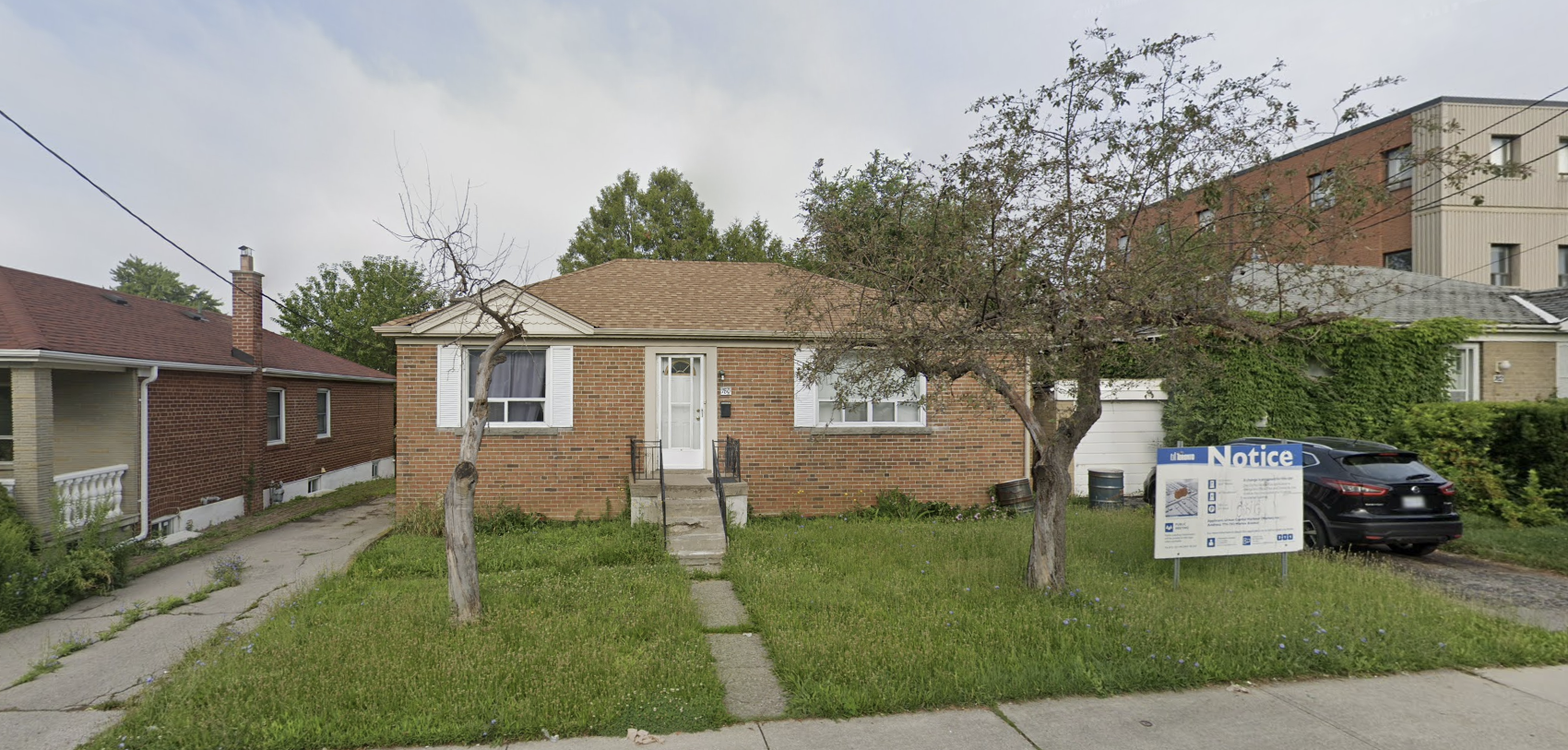
Marlee Avenue continues to be one of those corridors where Toronto’s long-term planning goals are becoming increasingly visible on the ground. What was once a collection of low-rise homes and modest apartment buildings is steadily giving way to larger, transit-oriented residential projects — each one reshaping how density is accommodated outside the downtown core.
The proposal at 774–782 Marlee Avenue is a clear example of that evolution. After several rounds of review and refinement, the application has returned to the City as a taller (24 storey), more intensive development than earlier versions. Below, we break down where the site is, what’s being proposed today, how the project evolved through resubmission, and why it matters for the broader Marlee corridor.
Where Is the Site and What’s There Today?
The subject site spans 774, 776, 778, 780 and 782 Marlee Avenue, forming a consolidated mid-block assembly along one of North York’s increasingly active arterial corridors. Marlee Avenue has long functioned as a connective spine between Eglinton West and Lawrence Avenue West, and in recent years it has become a focal point for tall-building residential intensification tied closely to transit access.
Today, the properties are occupied by low-rise residential buildings that reflect an earlier era of development—uses that are increasingly difficult to sustain on a corridor designated for growth. The lot assembly allows for a more comprehensive redevelopment approach, replacing fragmented buildings with a single, coordinated project that can better address streetscape, access, landscaping, and servicing in one move.

From a planning perspective, this stretch of Marlee sits within an area where the City has been clear about its intent: modest density along major roads, close to transit, delivered in a built form that transitions appropriately to surrounding neighbourhoods.
What Is Being Proposed?
The application proposes a new tall-building residential building designed to intensify the site while maintaining a strong relationship with Marlee Avenue at grade. The development is residential in nature, with a built form that steps and massing intended to balance increased density with pedestrian comfort along the street.

At a high level, the proposal replaces the existing low-rise structures with a purpose-built residential building that incorporates:
- A consistent streetwall along Marlee Avenue
- Residential units above a carefully designed ground floor
- Below-grade parking and servicing
- Landscaped areas that address both public and private realms
The design reflects a familiar planning pattern along Toronto’s avenues: adding housing supply where infrastructure already exists, while improving the public edge through widened sidewalks, new trees, and clearer pedestrian routes.
What Changed in the Resubmission?
Like many applications along major corridors, this project went through a detailed review process that resulted in a comprehensive resubmission. The updated materials respond directly to City comments and refine the proposal across several key areas.
One of the most notable shifts relates to transportation and mobility. The resubmission strengthens the Transportation Demand Management strategy, including dedicated car-share spaces, enhanced bicycle facilities, real-time transit information in the lobby, and commitments around PRESTO card incentives for residents. These measures reflect the City’s broader push to reduce auto dependency for sites located close to rapid transit.
The landscape strategy was also meaningfully revised. Updated drawings increase soil volumes, reconfigure tree planting along the Marlee frontage, and improve long-term tree viability by consolidating planting areas and reducing hard surfaces within tree protection zones. In plain terms: fewer decorative planters, more real trees with enough soil to survive.
From a technical standpoint, the resubmission tightens up driveway geometry, curb cuts, sidewalk widths, and right-of-way conveyances to meet City standards. These changes don’t dramatically alter how the building looks, but they materially improve how the site functions day-to-day for pedestrians, cyclists, and vehicles.

Transportation, Transit, and the Marlee Corridor
One of the strongest planning arguments for this proposal is its location. Marlee Avenue is well-served by transit and sits within walking distance of higher-order routes, making it an ideal candidate for residential density without a proportional increase in car traffic.
The project leans into this reality. Parking is provided, but not over-supplied. Instead, the application emphasizes cycling infrastructure, transit incentives, and shared mobility options. This approach aligns with how newer developments across the city are being evaluated—less focus on how many cars a building can store, and more attention on how people actually move through the city.
For the corridor itself, this kind of development helps reinforce Marlee’s gradual shift from an auto-oriented street toward a more balanced, pedestrian-friendly environment.
How This Fits Into the Bigger Planning Picture
With the current resubmission, the proposal at 774–782 Marlee Avenue should now be understood as part of the City’s tall-building intensification strategy along major corridors, rather than a traditional mid-rise avenue project.
Marlee Avenue already contains a number of existing and approved apartment towers, particularly closer to Lawrence Avenue West. In that context, the shift toward greater height on this site reflects a planning logic the City has increasingly supported: concentrating density on wide arterial roads with transit access, while preserving lower-rise residential areas behind them.
Rather than representing a sudden or isolated jump in scale, the 24-storey proposal aligns with the evolving built form pattern along Marlee, where taller buildings are gradually becoming the dominant typology.

How This Evolved From Mid-Rise to Tall Building
Earlier iterations of the proposal explored a more conventional mid-rise form. Through the review process, however, City feedback and technical analysis pushed the project in a different direction.
Key factors behind that evolution include:
- Lot depth and frontage: The assembled site is large enough to accommodate a taller building while still meeting tower separation, stepback, and sky view requirements.
- Transit proximity: Strong access to TTC routes supported a more intensive use of the site with reduced parking reliance.
- Unit efficiency: Moving vertically allowed the project to deliver a similar amount of floor area and housing supply with a smaller building footprint at grade.
- Public realm improvements: A taller form enabled wider sidewalks, tree planting, and clearer pedestrian zones along Marlee Avenue.
From a planning standpoint, this kind of evolution is common. Projects often begin as mid-rise concepts and transition to tall-building forms once massing studies demonstrate that additional height can be accommodated responsibly.
Community Impacts to Watch
As the application moves forward, there are a few areas residents and observers will naturally keep an eye on.
Construction timing and logistics will matter, particularly given the site’s proximity to existing homes and community amenities. Tree protection and post-construction landscaping will also be important, as the success of the public realm improvements depends heavily on how well those elements are executed, not just how they’re drawn.
There’s also the question of how added residential density translates into daily street life—more foot traffic, more local spending, and a gradual shift in how Marlee Avenue is experienced at different times of day.
What Happens Next?
The application continues through the City’s review and approvals process, with further refinement expected at the site plan stage. From here, the focus typically shifts toward implementation details: final materials, construction sequencing, and conditions tied to servicing, landscaping, and public realm works.
While timelines can vary, projects at this stage are generally moving closer to realization rather than rethinking fundamentals.
Why This Matters for Buyers, Renters, and Neighbours
Planning applications like this don’t just shape skylines—they influence housing choice, rental supply, and neighbourhood evolution over time. For renters, purpose-built projects along transit corridors can introduce new options outside the downtown core. For buyers and homeowners nearby, understanding what’s coming helps frame long-term expectations around change.
If you’re curious how current and upcoming development along Marlee Avenue may affect buying or selling decisions, we’re always happy to talk through the bigger picture.


