


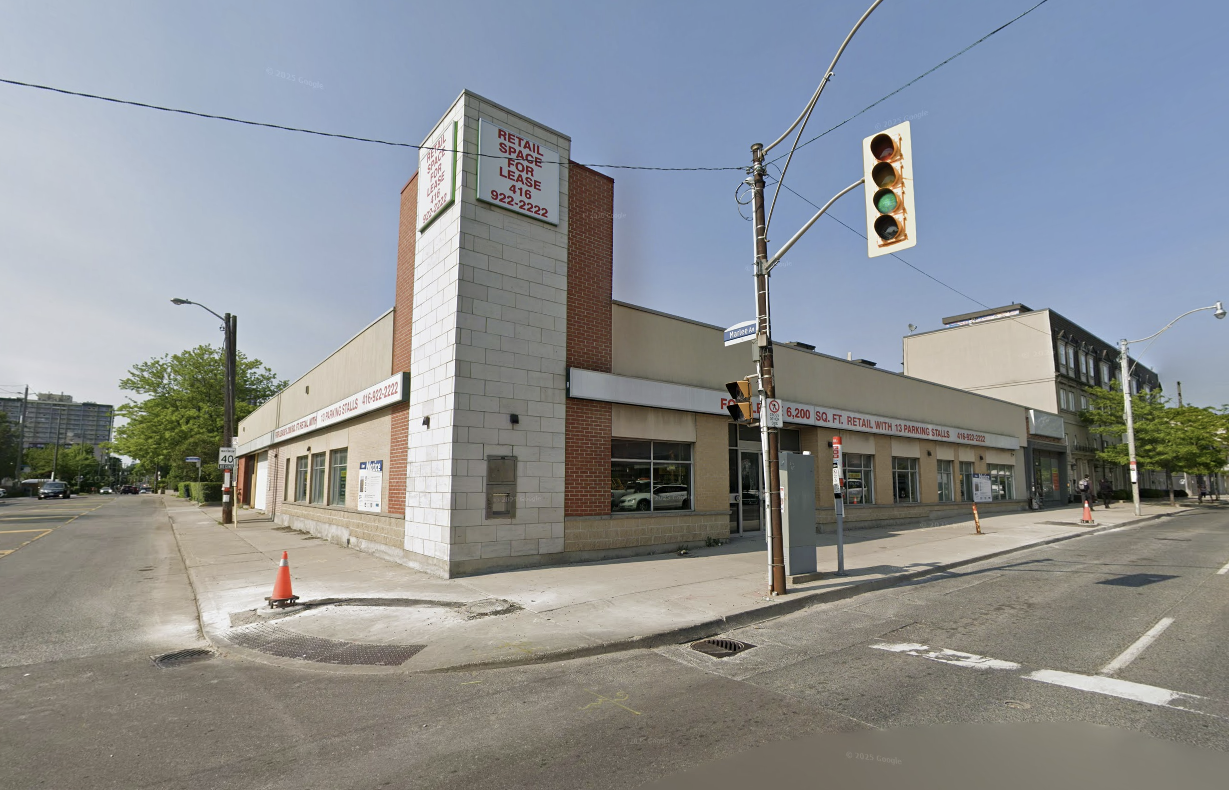
Eglinton Avenue West continues to evolve — and the latest proposal at 1410 Eglinton Avenue West adds another significant piece to that story.
A rezoning application has been submitted to redevelop the site with a 43-storey mixed-use building featuring a six-storey podium and a residential tower above. With 442 proposed units and a Floor Space Index (FSI) of 24.77, this application represents one of the more substantial intensification proposals along this stretch of the corridor. Let’s take a closer look at what’s being proposed, and what it could mean for Eglinton West.

Key Numbers at a Glance
- Height: 43 storeys
- Podium: 6 storeys
- Total Gross Floor Area: ~29,622.7 sq. m.
- ~183.4 sq. m. retail
- ~29,438.3 sq. m. residential
- Total Residential Units: 442
- Net FSI: 24.77
- Lot Coverage: ~71%
- Amenity Space: Indoor amenity on Levels 2 and 3
- Architect: Turner Fleischer
Site Context: A Changing Stretch of Eglinton West
1410 Eglinton Avenue West sits along a corridor that has seen a noticeable shift in planning applications over the past few years. With the Crosstown LRT now operational, sites within walking distance of transit stops are increasingly being positioned for higher-density redevelopment.
This proposal follows a pattern we’ve seen in other recent applications nearby — including towers proposed on Park Hill Road, Marlee Avenue, Stayner Avenue, and Romar Crescent. While each site differs in scale and configuration, the common thread is clear: proximity to higher-order public transit is driving increased height and density.
Eglinton West, in particular, appears to be entering a new phase — transitioning from predominantly mid-rise and low-rise conditions toward a more vertical built form along key nodes.
Built Form Breakdown
The Six-Storey Podium
The proposal features a six-storey podium designed to anchor the building along the street. At grade, the plan includes retail space (approximately 183 square metres) alongside the residential lobby, helping maintain an active frontage along Eglinton Avenue West.

Indoor amenity space is proposed on the second floor, with additional amenity and residential uses integrated into the third floor. Above that, the podium levels transition fully into residential units before the tower rises above.
The podium form is intended to reinforce the streetwall condition while stepping up to accommodate the tower element.
The Residential Tower
Above the podium, the 43-storey tower contains the majority of the 442 residential units. The tower floorplates appear compact and efficient, organized around a central core layout typical of contemporary high-rise design. With a total residential gross floor area of approximately 29,438 square metres, the project is overwhelmingly residential in nature, with only a modest retail component at grade.

What Does a 24.77 FSI Mean?
Floor Space Index (FSI) is a measure of density. It represents the ratio of a building’s total gross floor area compared to the size of the lot it sits on.
An FSI of 24.77 means the building contains nearly 25 times the lot area in total floor space. In practical terms, that signals a high-density urban development — the kind typically associated with major transit corridors and designated growth areas.
For comparison, low-rise neighbourhoods often operate at FSIs under 1.0, while mid-rise avenues might range between 3.0 and 6.0. An FSI approaching 25 reflects a significant intensification of land use.
This level of density is increasingly common near rapid transit infrastructure, where planning policy encourages more residents within walking distance of stations.
Transit-Oriented Development Along Eglinton West
The transformation of Eglinton Avenue West is closely tied to long-term transit investment. The Crosstown LRT has reshaped expectations for what this corridor can support in terms of built form and population growth.
Recent proposals along Park Hill Road (48 storeys), Marlee Avenue (26 storeys), Stayner Avenue (37 storeys), and Viewmount and Romar (36 and 39 storeys) reflect a similar trend: taller buildings clustered near transit access.
While each application will undergo detailed review and potential revisions through the rezoning process, the broader direction is consistent. Transit proximity continues to serve as the primary driver of height and density across the corridor.
Unit Count & Density Commentary
With 442 proposed residential units, this development would introduce a meaningful increase in population along Eglinton West.
Given the overall residential gross floor area and tower configuration, the unit mix is likely weighted toward one- and two-bedroom layouts, though final details would be confirmed through subsequent submission materials.

Amenity space distributed within the podium levels helps support this density internally, though the project remains largely residential in character.
Neighbourhood Implications
A 43-storey building represents a notable addition to the skyline along this stretch of Eglinton West. As additional proposals move forward in the area, a more vertical urban form is gradually emerging.
Retail at grade, increased residential population, and proximity to transit all point toward continued corridor intensification. Whether in its current form or a revised iteration, this application reinforces a broader shift already underway.
Eglinton West is evolving quickly — and projects like this illustrate how significantly the built environment may change over the coming decade.
What Happens Next?
The proposal is currently in the rezoning stage and will be subject to City review, technical studies, and community consultation. As with most applications of this scale, revisions are possible before any final approval. Timelines can vary, but large-scale projects such as this often take several years to progress from initial submission to potential construction.
Final Thoughts
The 43-storey proposal at 1410 Eglinton Avenue West is another clear signal of where this corridor is heading. With high-density development clustering near transit and multiple tall-building applications in motion, Eglinton West is steadily transitioning into a more vertical, transit-oriented urban environment.
For homeowners, investors, and future buyers, understanding what’s proposed — not just what’s built — is becoming increasingly important along this stretch of the city.
Thinking About Buying or Selling Along Eglinton West?
As new development continues to reshape the corridor, future supply, transit access, and neighbourhood change can all influence property values. If you’re considering buying or selling in the area and want to understand how upcoming projects may impact your decision, feel free to reach out for a conversation by sending us a message below!


