


Choosing the right neighbourhood in Toronto has always been about trade-offs — house versus location, commute versus lifestyle, budget versus long-term upside. For families, though, one factor consistently rises to the top: schools.
Each year, we see buyers reorganize their entire home search around secondary school catchments, often years before their children will actually attend. The reason is simple: strong schools don’t just shape education outcomes — they shape demand, pricing, and resale stability.
Using the Fraser Institute’s 2025 Report Card on Ontario’s Secondary Schools, this guide breaks down the best-ranked Toronto high schools, where they’re located, and what their performance means if you’re buying a home in the city.

Why School Rankings Matter More Than Ever for Toronto Home Buyers
In competitive markets, school quality acts as a price floor. Even during slower real estate cycles, neighbourhoods anchored by top-performing schools tend to see:
- more consistent buyer demand
- faster absorption when listings hit the market
- less volatility during broader market corrections
We see this play out repeatedly in Toronto. Families will compromise on square footage, renovation level, or even transit access — but they rarely compromise on schools once that priority is set. And because catchments are finite, timing becomes everything.
How the Fraser Institute Ranks Ontario High Schools
The Fraser Institute’s rankings are based on a school’s Overall Rating out of 10, which is derived primarily from province-wide EQAO data. In plain terms, the rating reflects:
- Grade 9 mathematics performance
- Ontario Secondary School Literacy Test (OSSLT) results
- consistency of outcomes across student groups
For this article, we’ve used only the 2023/2024 Overall Rating and filtered strictly to Toronto-based secondary schools. Five-year averages and trend indicators were intentionally excluded to keep this a clean snapshot of current performance.
Important context: rankings are a starting point — not a verdict. They don’t measure arts programs, school culture, or student fit. But from a buyer’s perspective, they remain one of the clearest indicators of where long-term demand concentrates.
The Best Toronto High Schools in 2025 (Fraser Institute Rankings)
Below are the top-ranked Toronto secondary schools, sorted strictly by their 2023/2024 Overall Rating. Ties are preserved exactly as published.

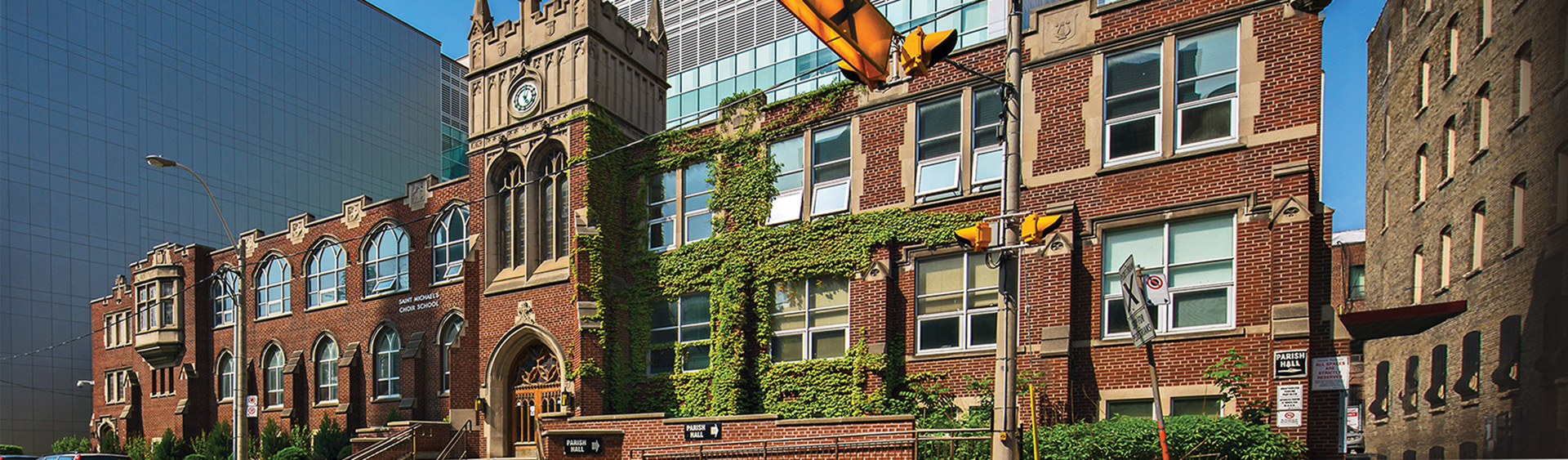
St. Michael’s Choir School — Overall Rating: 10.0
Neighbourhood: Downtown / Church–Wellesley
Consistently ranked among the very best in the province, St. Michael’s Choir School is a specialized institution with elite academic outcomes. Its downtown location means families often face a different housing equation — condo living versus traditional family homes — but for many, the academic reputation outweighs the trade-offs.
From a real estate standpoint, proximity to specialty schools like this often sustains demand for larger downtown condos and townhomes that might otherwise see more fluctuation.
Ursula Franklin Academy — Overall Rating: 9.7
Neighbourhood: Seaton Village / Little Italy
Ursula Franklin Academy is a prime example of how alternative education models can still deliver exceptional academic results. Its consistent ranking keeps Seaton Village and surrounding west-end pockets highly competitive.
We regularly see buyers here accept smaller homes or older housing stock simply to secure long-term access to this school environment.
Cardinal Carter Academy for the Arts — Overall Rating: 9.3
Neighbourhood: North York
Cardinal Carter challenges the assumption that only neighbourhood-based schools drive demand. As a specialty arts school with strong academics, it attracts families city-wide.
For buyers, this opens up flexibility: rather than overpaying in a specific catchment, families can sometimes buy more house in adjacent North York neighbourhoods while still accessing top-tier education.
Bloor Collegiate Institute — Overall Rating: 9.2
Neighbourhood: Bloor West Village / High Park North
Bloor CI anchors one of Toronto’s most walkable, family-oriented areas. Its academic performance reinforces long-term price stability throughout Bloor West Village and nearby streets.
Homes here rarely linger on the market, particularly those within easy walking distance of the school.
Leaside High School — Overall Rating: 9.1
Neighbourhood: Leaside
Leaside remains one of Toronto’s most school-driven neighbourhoods. The combination of strong academics, community feel, and housing stock keeps demand consistently high.
Buyers often face a clear decision here: renovate an older home or stretch for a turnkey option — either way, competition is the norm.
Lawrence Park Collegiate Institute — Overall Rating: 9.1
Neighbourhood: Lawrence Park
Few neighbourhoods demonstrate the connection between schools and pricing as clearly as Lawrence Park. LP CI’s long-standing academic reputation supports some of the city’s highest detached home values.
Families buying here are often thinking a decade ahead, not just about schooling, but about long-term generational value.
Malvern Collegiate Institute — Overall Rating: 9.1
Neighbourhood: Birch Cliff / Upper Beaches
Malvern offers a compelling east-end alternative. Strong academics combined with relative affordability (by Toronto standards) make this area especially attractive for families priced out of the city’s traditional school hubs.
This is one of the few pockets where buyers can still balance school quality with meaningful space.
Humberside Collegiate Institute — Overall Rating: 9.0
Neighbourhood: High Park / Bloor West
Humberside’s consistency reinforces demand throughout High Park and surrounding streets. Inventory here remains tight, and listings often attract multiple interested families within days.
Collège Français — Overall Rating: 9.0
Neighbourhood: Downtown Core
As a French-language public school, Collège Français draws families from across the city. Its presence helps support demand for downtown family-sized condos and townhomes, particularly among bilingual households.
York Mills Collegiate Institute — Overall Rating: 9.0
Neighbourhood: Hoggs Hollow / York Mills
Quiet, consistent, and often overlooked, York Mills CI anchors one of Toronto’s most stable luxury pockets. Low turnover and long-term ownership are defining features of this area.
Strong Performers Toronto Buyers Actively Target (Overall Rating 8.5–8.9)
Not every buyer needs — or wants — to compete for a 9.0+ catchment. In practice, many Toronto families deliberately target strong-performing schools just below the very top tier, where academic outcomes remain excellent but housing options can be more flexible.
These schools consistently come up in real-world buyer conversations, especially when balancing budget, space, and commute.
Earl Haig Secondary School — Overall Rating: 8.9
Neighbourhood: Willowdale East (North York)
Earl Haig is one of those schools that buyers bring up almost immediately when they’re looking in North York. Strong results, a well-known reputation, and a neighbourhood that offers everything from condo living to detached homes make it a practical (and popular) target.
From a real estate standpoint, the Willowdale East market tends to reward buyers who move early. Inventory can be seasonal, and the best family homes often draw attention fast.
A.Y. Jackson Secondary School — Overall Rating: 8.9
Neighbourhood: North York (Don Valley / Bayview Village-adjacent pocket)
A.Y. Jackson is a great example of a school that performs at a high level without requiring “top-tier catchment pricing” across every street. For buyers, that can translate into more options — especially if you’re open to different home styles (bungalows, side-splits, newer infill, or condo-townhome alternatives).
It’s a smart target for families who want strong academics and a straightforward commute into the core.
William Lyon Mackenzie Collegiate Institute — Overall Rating: 8.7
Neighbourhood: Bedford Park / Lawrence Manor / Allenby area
William Lyon Mackenzie is frequently on the shortlist for midtown buyers who want a balance of strong school performance and a family-friendly neighbourhood vibe.
Real estate-wise, this pocket can feel like a “best of both worlds” play: close enough to the core to keep lifestyle options wide open, but with more family housing stock than downtown. That said… when a good listing hits, buyers notice.
Riverdale Collegiate Institute — Overall Rating: 8.7
Neighbourhood: Riverdale
Riverdale CI consistently attracts families who want strong academics while staying connected to the east-end lifestyle — parks, walkability, and a community feel that’s hard to replicate.
From a buyer perspective, Riverdale can be competitive for a different reason: turnover is low. When the right home shows up, there’s often a line of families who have been waiting.
Richview Collegiate Institute — Overall Rating: 8.7
Neighbourhood: Etobicoke (Richview / Central Etobicoke)
Richview is a recurring “value versus location” conversation for buyers. Etobicoke gives families a bit more breathing room — often more space for the budget — while still keeping access to strong school performance.
If you’re comparing west-end Toronto versus central Etobicoke, Richview is one of the schools that can tip the scales for families who want a bigger home without leaving the city.
Bishop Allen Academy — Overall Rating: 8.7
Neighbourhood: Etobicoke (Islington / Bloor West-adjacent)
Bishop Allen is a strong option that often appeals to families prioritizing structure, community, and consistent academic performance — while also wanting quick access to subway lines and west-end amenities.
For buyers, the nearby housing mix (condos, townhomes, and detached options as you move outward) makes this a flexible target. It’s a good reminder that you don’t always have to choose between lifestyle and school strategy.
Why this tier matters for buyers
Neighbourhoods anchored by these schools often offer:
- slightly more inventory depth
- better value per square foot
- less emotional bidding pressure compared to the 9.0+ tier
For many families, this range represents the best balance between academic confidence and long-term affordability.
What These Rankings Mean for Toronto Home Prices
Neighbourhoods tied to top-ranked schools behave differently in the market. Even when conditions soften:
- sellers hold firmer on pricing
- buyer demand rebounds faster
- listings see fewer failed offer dates
In many cases, waiting for “better timing” simply means paying more later once competition returns.
Important Caveats for Parents Using School Rankings
Rankings don’t capture everything. They don’t measure:
- arts or athletics depth
- student support culture
- individual learning styles
Catchment boundaries can also change, and enrolment caps can affect access. This is why we always recommend verifying school eligibility before finalizing a purchase.
Buying a Home With School Catchments in Mind — Our Advice
The most successful school-focused buyers start planning earlier than they think they need to. Understanding neighbourhood supply, future boundary risks, and realistic budget trade-offs can make the difference between settling — and securing the right fit.
Final Thoughts
Great schools shape more than education — they shape neighbourhoods, pricing, and long-term value. For families buying in Toronto, understanding where academic performance and real estate intersect is one of the smartest moves you can make.
If you’re considering a move and want to align your home search with school strategy, we’re always happy to help you think it through – contact us by sending us a note below!


