


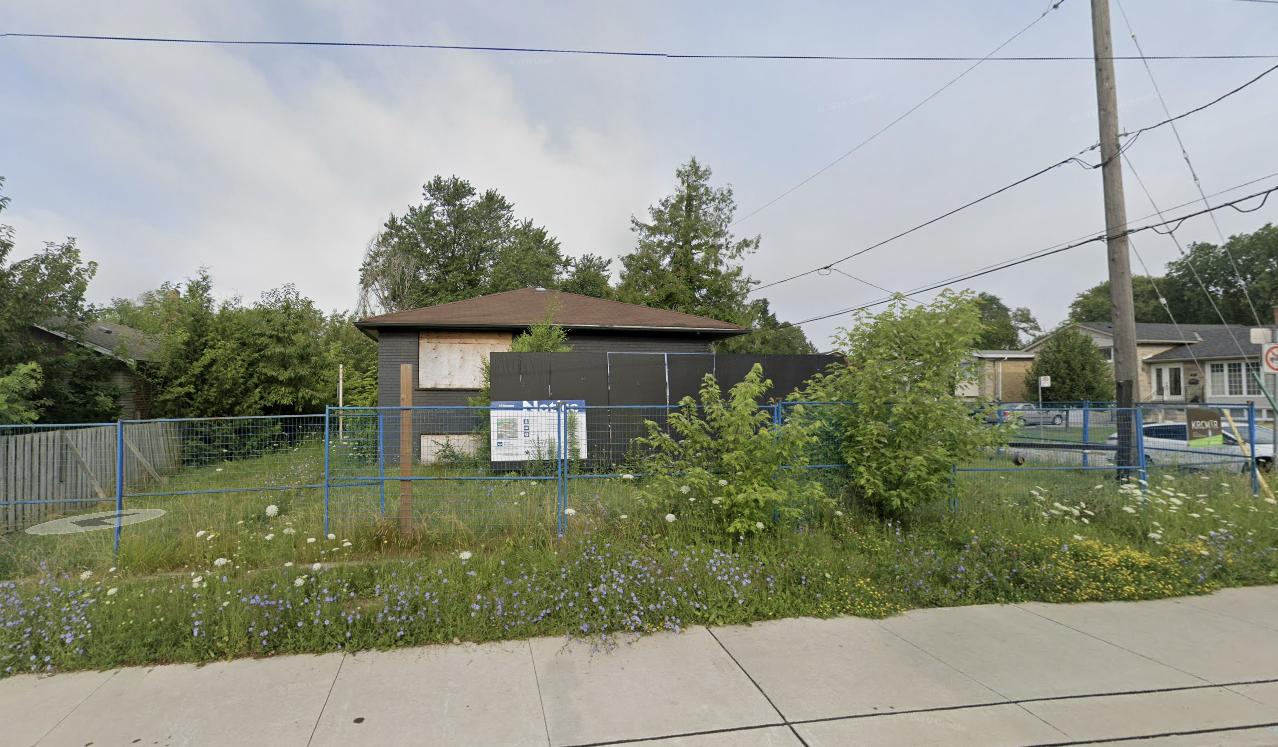
A Quiet Stretch of Marlee, About to Change
At first glance, the stretch of Marlee Avenue just south of Wenderly Drive doesn’t immediately signal major change. Low-rise homes, modest density, and a streetscape that still feels transitional rather than transformed. But that’s exactly why the latest development application at 744, 746, 748 Marlee Ave and 111 Wenderly Dr is worth paying attention to.
A new proposal has been submitted to redevelop these four properties into a 13-storey mixed-use building, adding 200 new homes and ground-floor retail to a corridor that the City now sees as a key growth area. And while this may feel sudden to nearby residents, the reality is that this site has been edging toward redevelopment for years.

The Site, in Context
The subject lands sit on the west side of Marlee Avenue, just south of Wenderly Drive, roughly 500 metres from Lawrence West Subway Station. Together, the four parcels total about 2,168 square metres, with significant frontage along both Marlee and Wenderly.
Today, each lot is occupied by a low-rise residential dwelling. But from a planning perspective, this location checks many of the boxes the City is prioritizing right now: proximity to higher-order transit, placement on a major street, and adjacency to an area already experiencing steady redevelopment pressure.
What’s Being Proposed
The application supports a 13-storey mid-rise, mixed-use building designed to bring new housing density to Marlee Avenue while maintaining a stepped transition toward nearby low-rise neighbourhoods.
Here’s what’s on the table:
- 200 residential units, ranging from studios to three-bedroom layouts
- Approximately 228 sq. m. of retail space at grade, focused on activating the Marlee/Wenderly corner
- Total gross floor area: ~13,115 sq. m.
- Floor Space Index (FSI): 6.04
- 45 vehicle parking spaces and 211 bicycle parking spaces
- Over 800 sq. m. of indoor and outdoor amenity space
The proposal includes both indoor amenity areas and outdoor spaces at grade and on upper levels, reflecting the City’s continued emphasis on livability in higher-density buildings.

A Site with Development History
This isn’t the first time these properties have been positioned for change.
Back in 2019, the City approved an Official Plan Amendment and Zoning By-law Amendment for a 10-unit, four-storey townhouse development on a portion of the site (746 and 748 Marlee Ave and 111 Wenderly Drive). That approval included road widenings and site plan conditions, many of which were ultimately satisfied.
However, the townhouse project was never constructed.
The current application essentially rethinks the site under today’s planning framework — one that places far greater emphasis on transit-oriented density and mixed-use development along major corridors like Marlee Avenue.
Why the Zoning Needs to Change
At present, the four properties are split between Residential Detached and Residential Townhouse zoning categories. The proposal seeks to:
This month at a glance
Toronto Real Estate Market Snapshot: September 2026
Average price
$1,006,409
▼ 5.1% year over year
Home sales
5,040
▼ 9.0% year over year
New listings
16,500
▲ 36.7% vs. August
Active listings
26,131
▲ 6.7% vs. August
Avg. days on market
51
Unchanged vs. August
The takeaway: Sellers came back in force this fall, but buyers didn't. Sales stayed flat while new listings jumped by more than a third, so buyers have more choice and more time to negotiate.
Read the full September report →Source: TRREB Market Watch, September 2026. Figures are for the Greater Toronto Area.
- Redesignate the lands from Neighbourhoods to Mixed Use Areas in the Official Plan
- Consolidate the site under a Commercial Residential (CR) zoning category
This change would allow for increased height, density, and a mix of residential and commercial uses — all elements that are restricted under the current zoning framework.
From a policy standpoint, the argument is straightforward: the site fronts a major street, sits near rapid transit, and aligns with the City’s growth strategy for intensification outside of stable interior neighbourhoods.
Marlee Avenue and the “Avenues” Effect
One of the most important background shifts here is Marlee Avenue’s identification as a new Avenue under the City’s updated planning policies.
Avenues are corridors where Toronto explicitly encourages mid-rise and mixed-use development to absorb population growth while protecting lower-density neighbourhoods elsewhere. In practical terms, that means sites like this are increasingly viewed as appropriate — even desirable — locations for taller, denser buildings.
Add in nearby subway stations, ongoing applications along Marlee, and the broader Growing Glencairn Study, and it becomes clear that this proposal isn’t happening in isolation. It’s part of a much larger recalibration of how this part of the city is expected to grow over the next decade.
Built Form and Neighbourhood Transition
While 13 storeys may sound tall in a low-rise context, the building has been designed with a series of step-backs and height transitions intended to soften its impact.
Key design elements include:
- A lower five-storey portion at the north end near Wenderly Drive
- Rear setbacks exceeding 12 metres from the lot line
- Upper-storey step-backs to preserve light, sky views, and privacy
- Landscaping buffers and screening along the west edge of the site
The intent is to maintain a clear transition from the Marlee Avenue corridor into the adjacent residential neighbourhood to the west.
What This Means for the Area
If approved, this project would add 200 new homes to a stretch of Marlee Avenue that’s already seeing steady intensification. For the City, that means progress toward housing supply targets in a transit-accessible location. For the neighbourhood, it signals a continued shift away from low-rise character along the main street.
It also reinforces a broader pattern we’re seeing across Toronto: sites once approved for townhouses or low-rise forms are being revisited as mid-rise or mixed-use projects as planning priorities evolve.
What Happens Next
The proposal requires both an Official Plan Amendment and a Zoning By-law Amendment, meaning it will go through a detailed City review process, including technical analysis and public consultation.
As with most applications of this scale, the final outcome may evolve — through revisions to height, massing, or unit mix — before a decision is reached. But the direction of travel is clear: Marlee Avenue is no longer being planned as a low-rise corridor.
For anyone tracking what’s being built in Toronto, this application is another data point showing where growth is being steered, and how quickly long-standing assumptions about certain streets are changing!


