


What Is a Den? Condos, Houses and What It Means for Buyers in Toronto.

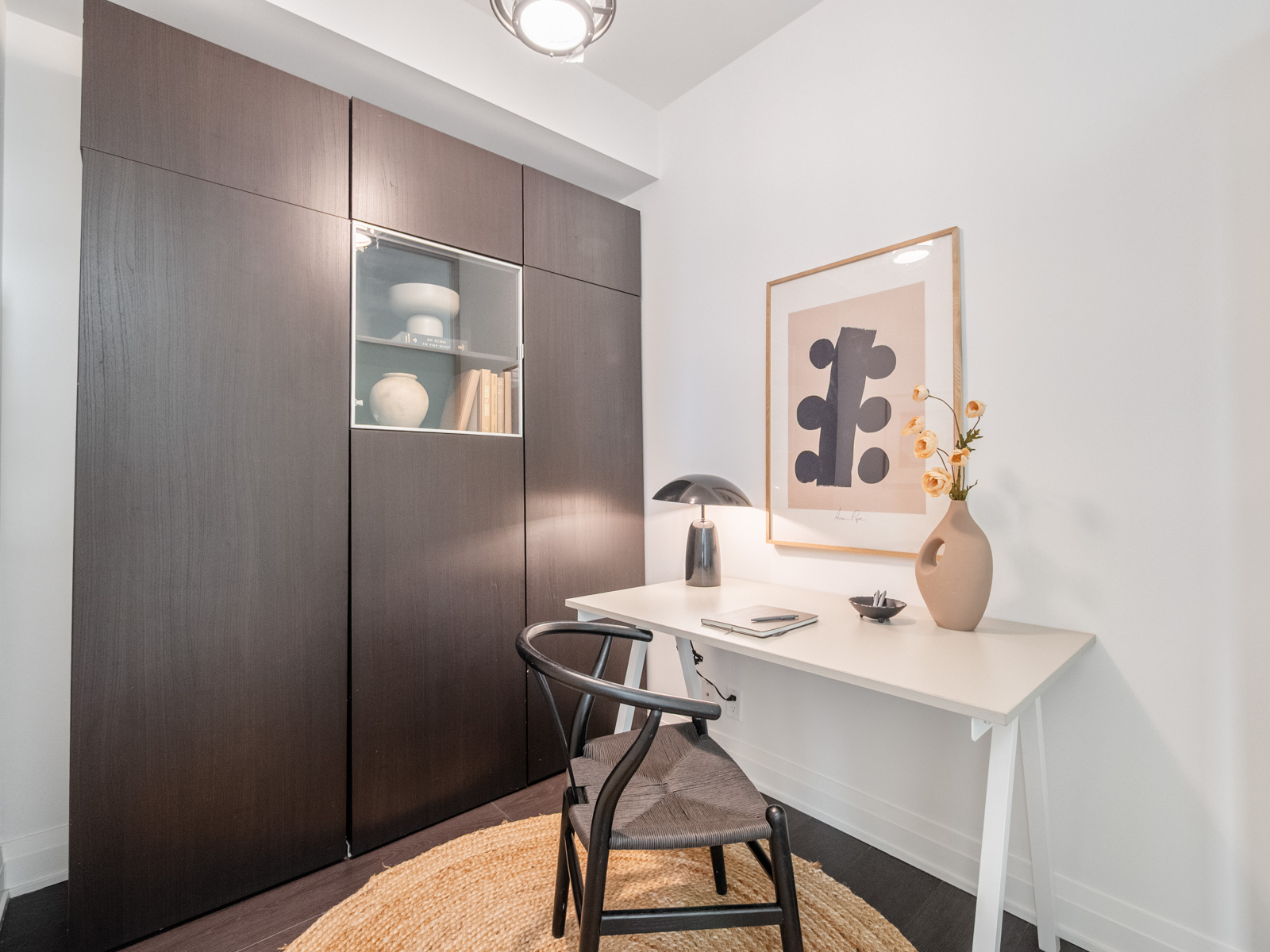
A windowless den set up as a home office, with a full-height wall unit for storage.
A den is a smaller extra room that doesn’t qualify as a bedroom. In a Toronto condo, that usually means it has no window, it’s too small, or it’s open to the rest of the suite with no door. In a house, “den” tends to mean something a little different: a family room, a study or a TV room, usually with a window and plenty of space.
If you’ve ever walked into a “1+den” and spent a minute looking for the den, you’re in good company. There’s no official definition of a den in Ontario. When CBC News looked into it in 2019, neither the Ontario Real Estate Association, the Real Estate Council of Ontario nor the City of Toronto could give one. What the rules do define is a bedroom, so that’s the easiest way to understand a den.
Here’s what the Building Code says, what “1+den” and “2+den” mean on a Toronto listing, and what we look at when we walk a client through one.
What Is a Den, Exactly?
A den is whatever extra room the builder or seller decided not to call a bedroom. That’s it. In practice, it can be anything from a nook beside the kitchen that fits a desk to a closed room with a door that fits a queen bed.
The name almost always starts with the builder. A pre-construction floorplan labels the room “den,” the MLS listing repeats it, and the label sticks for every resale after that. So two condos listed as 1+den can have very different dens, even in the same building.
Den vs Bedroom: What the Ontario Building Code Says

A bedroom needs a window to the outside. This one has a full wall of glass.
Ontario’s 2024 Building Code, in effect since January 1, 2025, sets minimums a room must meet to be a bedroom. According to Part 9 of the Building Code, here’s what applies:
- Size. A bedroom needs at least 7 m² (about 75 sq ft) of floor area, or 6 m² (about 65 sq ft) if it has built-in storage like a closet. At least one bedroom in every home needs 9.8 m² (about 105 sq ft), or 8.8 m² (about 95 sq ft) with built-ins.
- Ceiling height. At least 2.3 m over half the required floor area, or 2.1 m over all of it.
- A window. Rooms used for sleeping need windows. As the City of Burlington’s building department explains, the Code sets the minimum glass area at 5% of the room’s floor area. This applies in condo towers too, although some building departments accept a bedroom that borrows its light through a large glass wall from a room with a window.
- An escape window (houses). In a house, every floor with a bedroom needs at least one window that opens from the inside without tools, with an opening of at least 0.35 m² and no side shorter than 380 mm, unless there’s a door to the outside on that floor. High-rise condo buildings follow a different part of the Code, where you leave through the corridor and exit stairs instead.
What about closets? This is the part that catches people. The Building Code doesn’t require a bedroom to have a closet. It only lets a bedroom be a little smaller if it has one. “No closet, no bedroom” is a long-standing industry habit, and plenty of buyers expect a closet in a bedroom, but it isn’t a Code rule.
In other words, most condo dens are dens because they have no window, or because they’re too small. A missing door or closet is usually what turns a bigger room into a den on the listing.
What “1+Den” and “2+Den” Mean in Toronto Listings
A 1+den is a one-bedroom suite with a den. A 2+den is a two-bedroom suite with a den. On an MLS listing, you’ll usually see these written as “1+1” and “2+1”: the first number counts bedrooms, and the number after the plus sign counts extra rooms that the listing agent didn’t count as bedrooms.
That second number doesn’t always mean a den. In a house, a “3+1” often means three bedrooms upstairs plus a room in the basement, which may or may not meet the bedroom rules above. In a condo, “+1” almost always means a den.
If you’re browsing downtown condos, you’ll come across a lot of 1+den layouts in Waterfront Communities C1 and the Bay Street Corridor, where you can also check Bay Street Corridor condo prices before you book a viewing.
Enclosed Dens vs Open Alcoves

An enclosed den with no window to the outside. A ceiling light and plenty of storage make it a workable office.
Not all dens are rooms. Roughly speaking, they come in two types.
Enclosed dens have walls and a door, sometimes a sliding or glass one. These are the useful ones. You can close the door on a work call, put up a guest, or keep a crib away from the TV. Some are big enough that the listing says “can be used as a second bedroom.” When we see that, we ask the obvious question: why isn’t it called one? Usually it’s the window. Sometimes the “window” looks into the living room or a solarium rather than outside.
Open alcoves are nooks off the kitchen, hallway or living room with no door. They’re great for a desk, a bookshelf or a dining table, and that’s about it. They don’t add privacy, and they don’t add much to resale value.
What People Actually Use a Den For

A Murphy bed folds away, so a small room can be an office most days and a guest room when you need one.
From what we see with our clients, most dens end up as one of these:
- A home office. Since 2020, this is by far the most common use. An enclosed den with a door makes working from home much easier.
- A nursery. A small enclosed den can work well for a baby’s first year or two, especially if it sits near the primary bedroom.
- A guest room. A sofa bed or a Murphy bed turns a den into a room for visitors without giving up the space the rest of the year.
- Storage. In a condo with a small locker (or none), the den often becomes the place for bikes, luggage and the vacuum.
Can a Den Be Used as a Bedroom?

This small second bedroom has a window and a door to the balcony. Many dens have neither.
Plenty of people sleep in dens, and it’s your home. That said, here are the practical things to think about (this isn’t legal advice).
No window means no daylight and less fresh air. A windowless room can feel stuffy and dark, and it’s harder to wake up naturally. Check whether the den has its own air vent. In many condos, heating and cooling come from one unit in the living area, so a den with the door closed can run noticeably warmer or cooler than the rest of the suite. Our guide to condo heating systems explains how each type works.
Think about getting out in an emergency. In a house, and especially in a basement, a room with no window has no second way out. We wouldn’t use one as a bedroom. In a high-rise condo, your way out is the suite door and the exit stairs, so the bigger question is whether you’d hear the smoke alarm with the den door closed. Test it.
If you rent the suite out, describe the den honestly. Calling a den a bedroom in a rental listing sets the wrong expectation, and tenants notice.
How a Den Affects Resale Value and Rent
In general terms, a good den adds value. In the same building, a 1+den usually sells and rents for more than a plain one-bedroom and for less than a true two-bedroom.
How much more depends on the den:
- An enclosed den with a door, a sensible size and good light adds the most.
- An open nook adds a little, mostly as extra square footage.
- A den that’s really a hallway with a label adds close to nothing, and buyers can tell.
Keep in mind that the den is already part of the suite’s square footage, so you’re paying for it either way. The question is whether that space works for how you live. If you’re selling, show the den set up for a real use, like an office, so buyers can picture it. It’s one of the things we weigh when we look at how Toronto realtors determine property value.
What to Check When You View a Den
Here’s the checklist we use when we’re touring a 1+den or 2+den with a client:
- The door. Is there one? Does it close fully, and is it a swing or sliding door? A den that can’t close is an alcove.
- The window. Is there one, and does it look outside or into another room? Interior glass lets in some light, but it isn’t the same.
- The size. Bring a tape measure. Will a desk and chair fit with the door closed? Will a double bed fit with room to walk around it?
- The closet. Not required by the Code, but it changes how useful the room is, especially if you plan to use it as a guest room.
- Air and temperature. Look for a supply vent. Stand in the room for a minute with the door closed and see how it feels.
- Outlets and lighting. Many dens have no ceiling light and only one outlet. Fine for a desk lamp, less fine for an office with two monitors.
- Where it sits. A den next to the living room or the elevator shaft can be noisy. One near the primary bedroom works better as a nursery.
Buying new? The den is one of the rooms to check carefully at your condo PDI, since a floorplan rarely shows exactly how the space will feel.
Dens in Houses vs Dens in Condos

Most of the dens we see are in condo towers like this one in midtown.
In a house, a den usually means a real room: a family room off the kitchen, a study at the front of the house or a TV room in the basement. It almost always has a window. In many older Toronto houses, the den is the small room off the living room that the original owners used as a library or sitting room.
In a condo, the den is usually smaller and sits in the middle of the suite, which is why it so often has no window. Condo suites have also gotten smaller over the years. In March 2026, the Toronto real estate news site Storeys reported that the average Toronto condo shrank by about 35% between the mid-1990s and 2022, from roughly 1,100 sq ft to 700 sq ft, and the den shrank with it.
Weighing the two? Our post on house vs condo in Toronto walks through the bigger trade-offs, and here’s how we approach buying a condo in Toronto.
Frequently Asked Questions
Is a den worth paying for?
It depends on how you’ll use it. If you work from home or need a guest room, an enclosed den with a door is worth a lot more than an open nook. If you’d never use it, a well-laid-out one-bedroom with a bigger living room may suit you better.
Can you put a bed in a den?
Yes, if it fits. Measure first, and think about light, air and how you’d get out in an emergency. In a house or basement, we wouldn’t use a windowless room as a bedroom.
Does a den count as a bedroom on MLS?
No. On Toronto listings, a den shows up after the plus sign, as in “1+1.” The listing agent decides how to count rooms, so always check the floorplan and see the room in person.
Is a 1+den better than a 2-bedroom?
A true two-bedroom gives you a second room with a window and usually a closet, which matters for a roommate, a child or resale to a family. A 1+den is often more affordable and works well for one person or a couple who needs an office. Compare them on how you’ll live in the space, not just the bedroom count.
Can a den have a window?
Some do. A den with a window may still be called a den because it’s too small to be a bedroom, has no door, or because the builder chose to label it that way.
What’s Next?
Toronto real estate news site Storeys has asked whether the small windowless den is on its way out as more buildings are designed for people who’ll actually live in them. Will the next wave of Toronto condos trade the den for bigger bedrooms and real second rooms? It’s a trend to watch, and we’ll share what we see.
Looking at a 1+den and not sure the den will work for you? Get in touch with our team and we’ll walk through it with you.
For sale in Toronto
Luxury homes.


Still have questions?
Send us a message.
We’ll get back to you quickly.
Keep reading
More buying advice.


Have a question
Get a straight answer from our team.
Ask us anything about buying or selling in Toronto.